BIF Blog Birds In Focus
https://birdsinfocus.com/blog
Birds In Focus BlogTue, 20 Aug 2024 04:44:06 +0000en-US
hourly
1 https://wordpress.org/?v=6.9.4Chasing the Black Rosy-finch
https://birdsinfocus.com/blog/2024/08/20/chasing-the-black-rosy-finch/
Tue, 20 Aug 2024 04:42:45 +0000https://birdsinfocus.com/blog/?p=617Continued]]>Adventure Planning
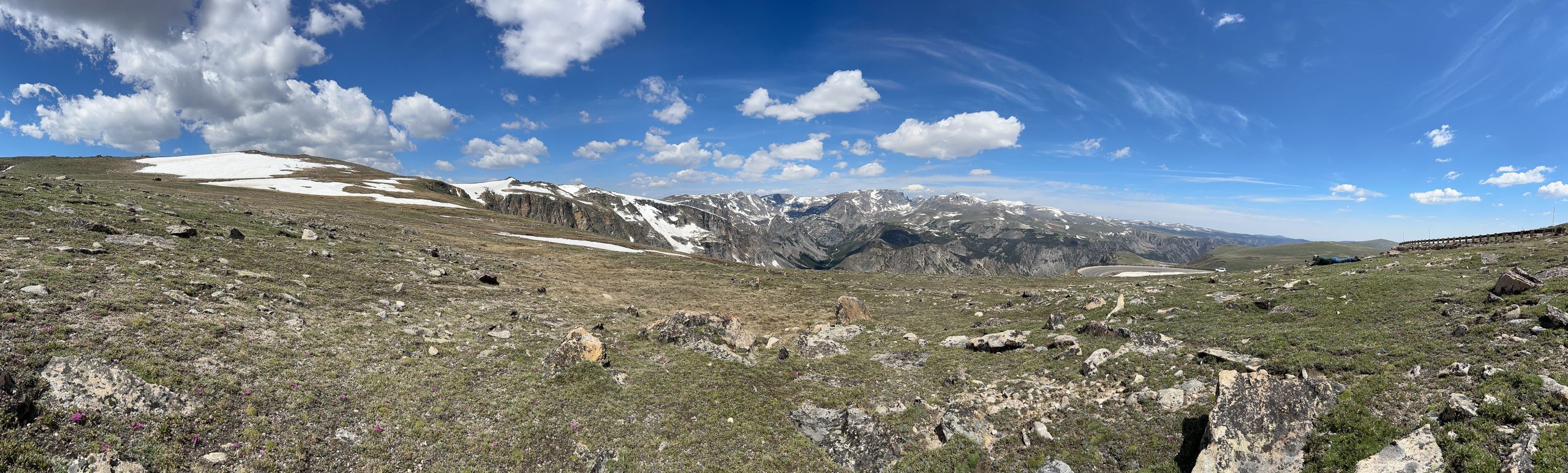
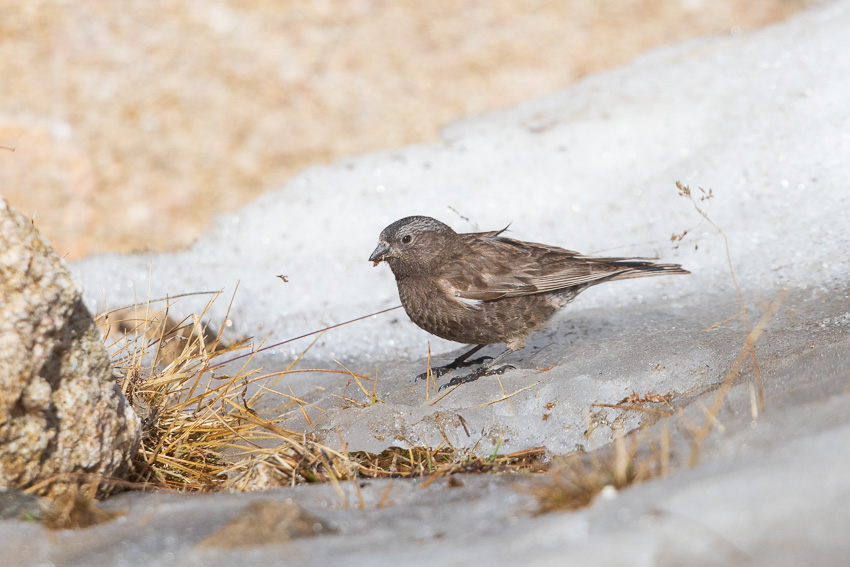
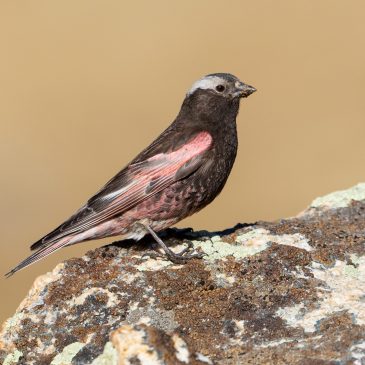
When you talk to a birder who has seen a Black Rosy-Finch you’ll likely hear a story about a nomadic winter bird at a feeding station in a mountainous area (often with other rosy-finch species). Indeed that is where I saw my own “lifer” Black Rosy-Finch in January 2022, but where do these birds spend the summer months? The answer requires imagining some of the highest, windiest, rockiest corners of the North American mainland. When I stumbled upon an article from Audubon that explained that only 23 nests has been found prior to 2002, I was hooked. I knew that I had to plan a trip to chase this bird!
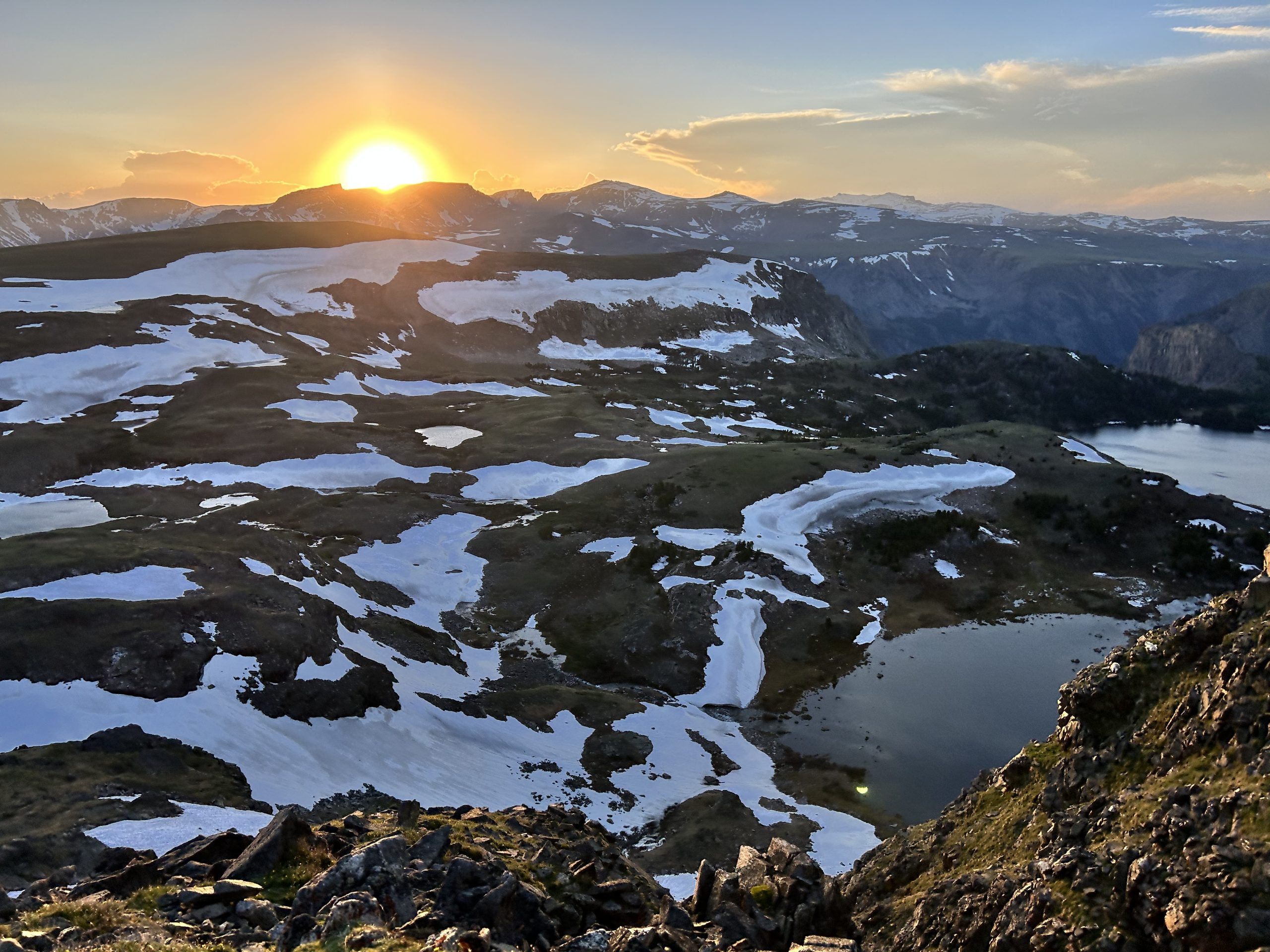
Sunset on the beautiful Beartooth Highway – home to Black Rosy-Finch
The adventure started to materialize one day this past February when I sat down and dug in on the research phase. My mind was initially intrigued by sightings in the Ruby Mountains of Nevada (also home to Himalayan Snowcock – another story for another day) or perhaps the Uintah Mountains of Utah. But then my eyes danced northward to the Beartooth Highway. Not only did that seem like a good spot for my avian target, but that entire road snaked along alpine ridges from Montana to the Northeast entrance of Yellowstone National Park and had long been on my wishlist for the sheer beauty alone. I hurriedly put together a draft rosy-finch itinerary and sent it off to my birding buddy Bob Gress. His response came quickly “Wow! Great trip plan!” but unfortunately he already had a Pacific Northwest road trip in the works. Dang. I tabled the idea, thinking that 2024 would not be the year.
But a week later Bob sent another message “I keep looking at this……a great trip”. The hook was clearly set and our mutual interest was high! Thankfully by April we had a plan in place where Bob could still do his trip to the Washington coast and then he’d pick me up for a second adventure along the Beartooth Highway.
A Plan in Action
When June rolled around and the snow melted enough for the Beartooth Highway to open, it was go time! We packed up Bob’s camper van, “The Peregrine” and were on our way north. We arrived in the late afternoon, hopped out of the vehicle and were nearly blown over by a viscous (and cold) wind. Still, after so much anticipation we had to give it a try!
After some diligent searching we managed to find one female who was feeding slowly along a snowbank, but that remained our only sighting for a while…and then they were suddenly everywhere. It was rosy-finch madness as a big flock flew (or maybe they were blown) across the road and into an area with rocks and melting snow. They hopped up here and there, tails bending in the wind, and then just as quickly were gone to a downslope area that appeared to be a completely inaccessible nesting area. Those initial photos weren’t great, but they were a start! We would try again in the morning.
The next morning dawned clear and much less windy, so we set to our quest. But a couple hours later we only had occasional glimpses to share. Given their cliffside nesting areas, male Black Rosy-finches don’t defend a specific territory, but they do follow their mate around and fend off rivals as necessary. The key, it would seem, would be to find active foraging locations where the males would be interacting and (hopefully) pausing long enough for a few photos.
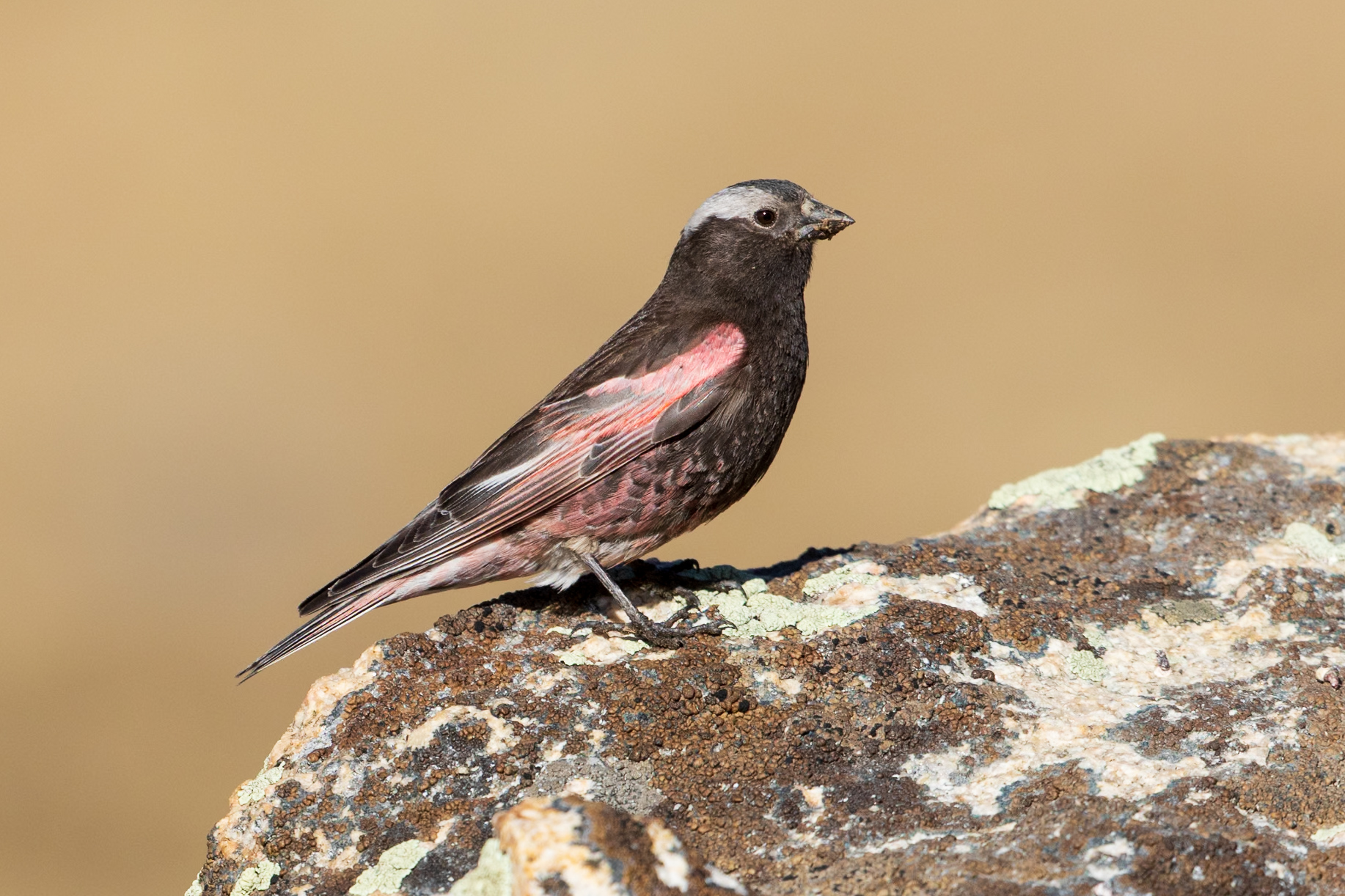
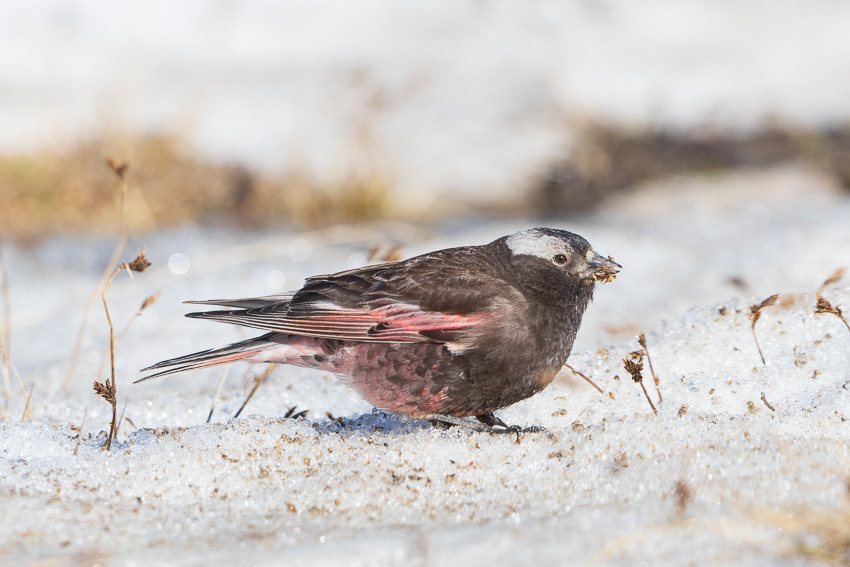
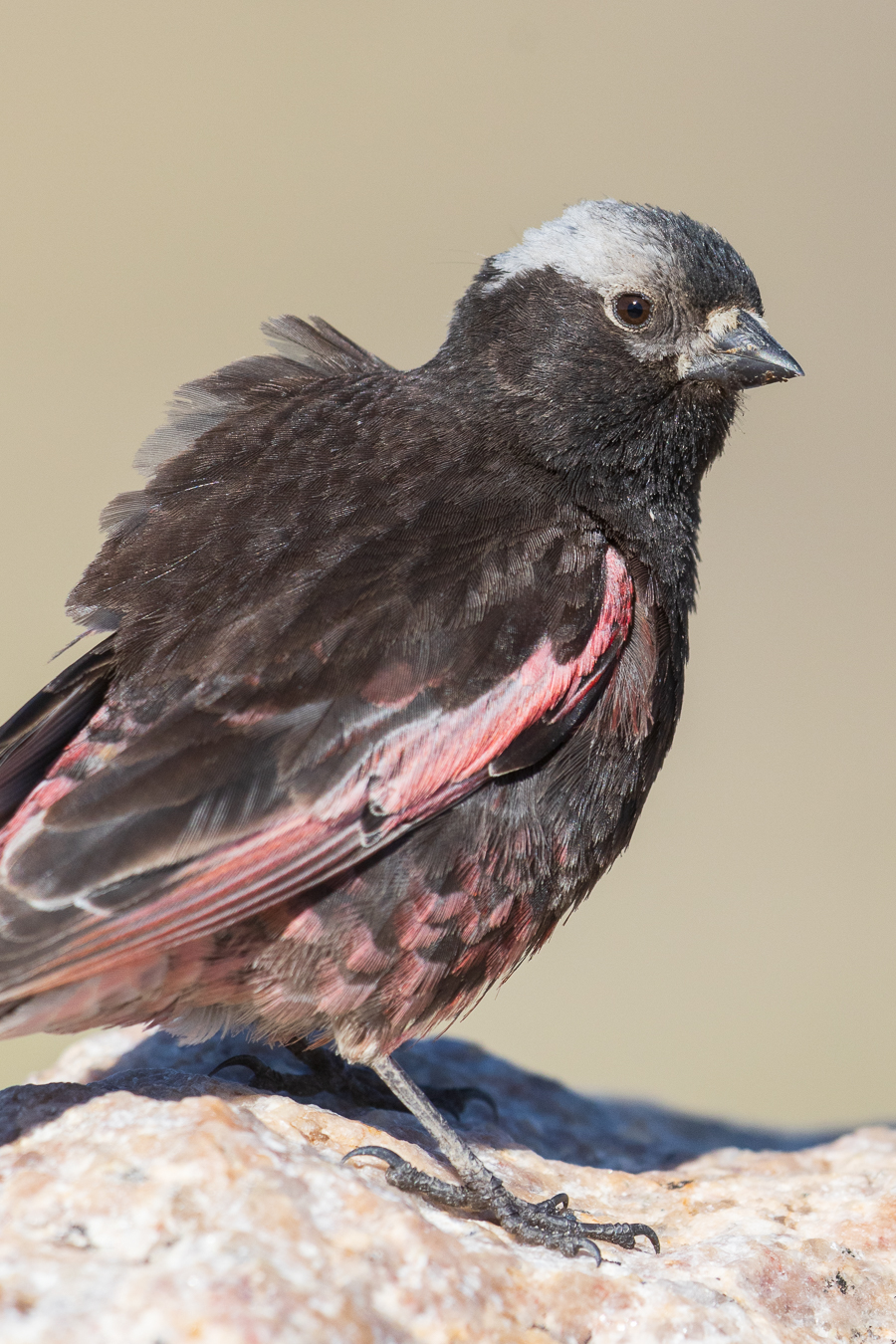
The second morning was another great day, and we took off over the hills to find an area where we felt the birds were foraging. The snow was rapidly melting and looked completely different from the previous morning, but our strategy worked and soon we had the perfect conditions with more than a dozen rosy-finches that were periodically feeding, chasing each other, and sometimes landing on big rocks scattered across the tundra. Oh that was the shot! Bob and I got to work and we took a ton of photos of this amazing pink and black bird!
In the words of Bob, it was an “Oh baby!” moment and we high-fived each other and knew we had captured what had dreamed up those many months earlier. The Black Rosy-Finch adventure had been a total success, and now it was time to move down the road and see what Yellowstone National Park had in store for us!
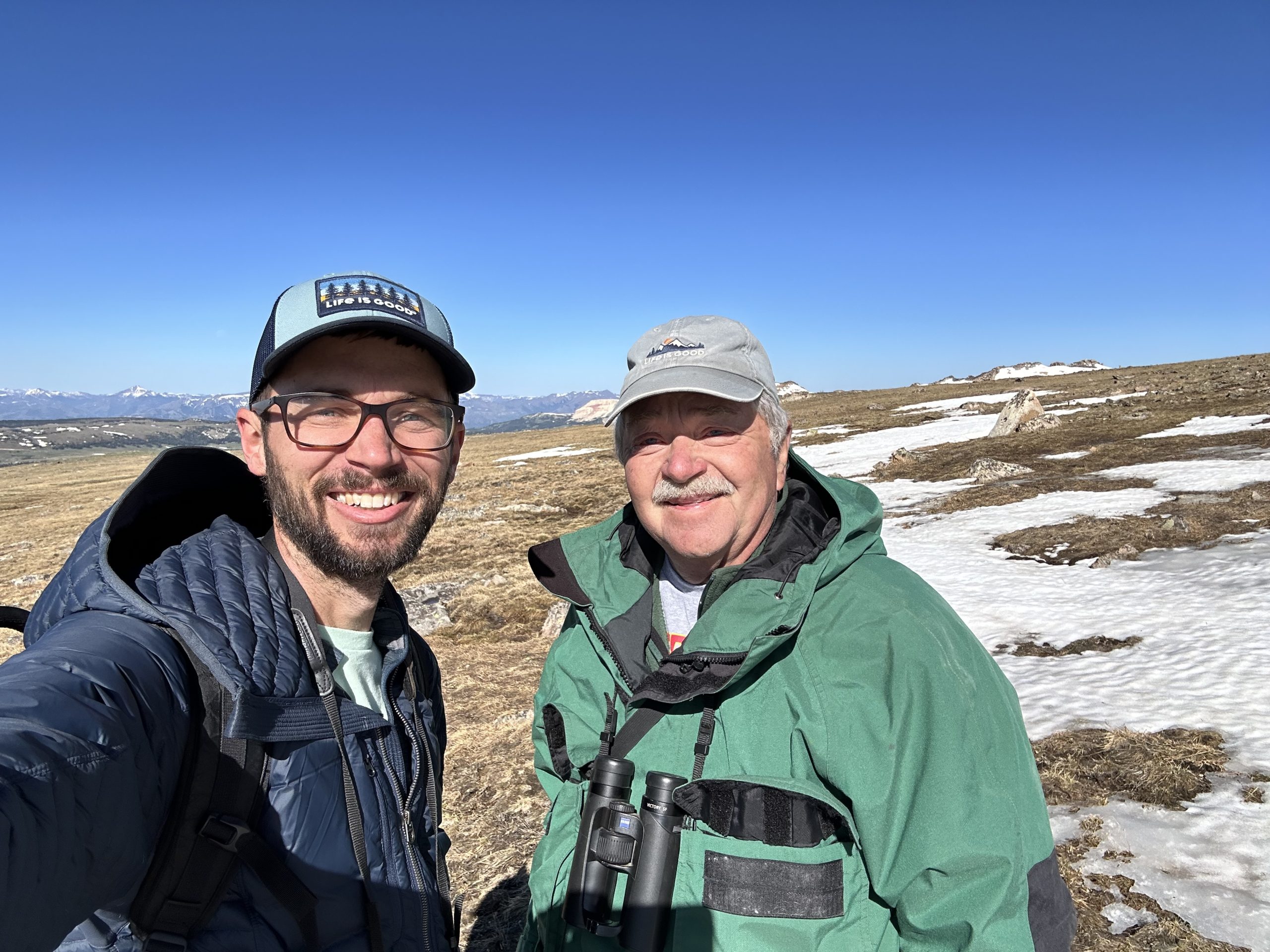
Happy photographers after Black Rosy-Finch success!
]]>A Zillion Miles of Birding: Days 7-11
https://birdsinfocus.com/blog/2020/01/25/a-zillion-miles-of-birding-days-7-11/
Sat, 25 Jan 2020 17:53:04 +0000http://birdsinfocus.com/blog/?p=560Continued]]>Here is a continuation of the grand adventure that Matías is having in southern Argentina. If you missed the earlier blog entries, please look here for Days 1-3 and Days 4-6.
Day 7
From the town of Camarones I drove south for about 40 kilometers to visit a provincial reserve called “Cabo Dos Bahias”. I had learned along my journey to be flexible, as Patagonia continues to surprise.
Along the road I decided to take any short trail that would take me to the beach, and on those I found both morphs of the Variable Hawk. The first photo shows an adult on a nest. It’s not a great photo because there were chicks and I didn’t want to disturb them. The second photo shows the uncommon gray morph.
Also in a small bay I found a number of steamer ducks, a Chilean Flamingo running to take off, and quite a few Patagonian Crested Ducks.
At the Reserve itself, in a somewhat small area, the wonders of nature allowed for harmony between several species. The place is a Magellanic Penguin colony where Lesser Rheas walked freely. Guanacos (newly born and adults) enjoyed the sunny afternoon, penguins minded their own business, whilst their predators (Kelp Gulls, Southern-crested Caracaras and Skuas) did their part. And a fluorescent looking lizard managed to catch some insects.
The harmonious day finished when these guys invited me to join their party. It was time to return to Camarones.
Day 8
Camarones gave me plenty of photos and great times but the moment had come to head to Puerto Deseado in the Province of Santa Cruz. As usual I could choose the ‘easy way’ or the ‘Matías’ way’ and of course I took the dirt road that would lead me to Comodoro Rivadavia (in Santa Cruz Province) where I planned to refuel. I was facing a drive of about 600 kilometers, and according to the map, about half of it would be on a dirt road.
My wife, Andrea, had given me an assignment and requested that I check a place along the dirt road called Bahia Bustamante Lodge (about 60 kilometers from Camarones). A fair road took me to the place that according to the internet is a dreamy spot, but the reality is completely different! The lodge looked untidy and abandoned, and the only soul around was a Patagonian Gaucho with whom I briefly spoke about the facilities. As I was ready to leave, in a typical gaucho intonation he asked me “Which road are you taking?” and in all seriousness I answered “I don’t really know, but it is marked on the map as a road that takes me to Ruta 3 and then on to Comodoro.” His expression told me he must think that I am on drugs, but after a few seconds he added calmly “Don’t forget to close the gates as you go by.” We shook hands and I took the road on the map.
I honestly loved my new “road” but having survived the adventure I would recommend doing it with two 4WD vehicles and especially not by yourself with a vehicle approaching 400,000 km on the odometer!
The road took me through mountains that I didn’t know existed. I crossed many streams on bridges that had seen better days and some with enough water to generate problems. At certain points the road turned into a trail with many alternative trails due to water washing various routes away. As I was finishing this so called road a heavy storm with extreme winds fell on the old station wagon. Until the storm, I was loving my adventure…but I did get a little worried.
Despite the fact that the driving took most of my attention I managed to take some photos. I saw some Least Seedsinipes that are more frequent along the Andes Range, males (1st photo) have a grayish breast with a black tie like stripe, whilst on females breast is alike the rest of the plumage (2nd photo).
I also photographed a Patagonian Yellow-finch that is endemic to Patagonia and Tierra del Fuego (Argentina and Chile), and I came across one single Tawny-throated Dotterel. This was fortunate because it will become harder to observe this species as I go west in the province. Several Austral Negritos were also photographed (the female is shared here).
And I had two very rare sights. The first were a few Spectacled Tyrants which are hardly ever observed this far south in Argentina (photo shows a female). And the other one is really more than rare…it was extraordinary: an albino Guanaco. I have only heard of a couple similar specimens along the Andes Range, but never so close to the Atlantic Ocean.
The storm was just above me and it didn’t look good, so I stopped the photography and got to driving. I left Camarones at about 9:30 am and arrived at Puerto Deseado at 9:30 pm. I won’t be going any further south of Argentina, but have already driven 2793 kilometers (1735 miles). The Legacy carries a lot of extra weigh made up of dirt, and I still have almost twice this mileage to return home.
Day 9
I arrived at Puerto Deseado and soon learned the reason for the name. Back in 1586 a corsair named Cavendish arrived in this part of the world with a ship named Desire (translates into deseo in Spanish). He named the area after his ship and some time later the name was changed to Puerto Deseado and a cape was named cape Cavendish after the corsair.
A renowned member of the English Scientific Society, Mr Charles Darwin, also visited these lands and camped here back in 1833 to study the “birds that didn’t fly” amongst other wonders of the place. Perhaps, Darwin saw much of what I have seen this day in my own expedition. We left by mid-morning on a boat with heavy winds and a rough sea to observe the birds placed second on my wishlist. It is a Near Threatened species that inhabits only a few places of the coasts of the Pacific Ocean from Perú to central Chile and it also occurs in Puerto Deseado, Santa Cruz Province, Argentina: Red-legged Cormorant.
The Red-legged cormorant is a wonderful bird that nests in cliffs on near-shore islands. In my opinion, it is the nicest member of the Phalacrocoracidae family and I was able to come a few meters away from them (on a boat). They mate for life and share incubation of their eggs, so when one is incubating the other adult is in charge of bringing the food.
They shared this particular island with a colony of Rock Shags of which I have already posted some photos, but here are some better ones.
There were many other species in the few islands that we visited following Darwin and another interesting one that was included on my wishlist was the Dolphin Gull.
And most likely Darwin also saw a relative of this splendid South American Sea Lion.
It is a thrill to follow the paths of corsairs that named unexplored lands and scientists that elaborated theories that persist to the present. Tomorrow I will remain in Puerto Deseado until around 3 pm and then I will drive West to the small village of Perito Moreno in northwest Santa Cruz Province.
Day 10
We pulled away from the dock at 8 AM sharp accompanied by a group of four biologists, an Italian couple, a Swiss couple that was traveling around Argentina in a motorhome, two Germans, and a Welsh Family. My expectations were high and I hoped not to get seasick because we had a 40 minutes ride to “Isla Pingüino/Penguin Island”. The name conjures up thoughts of a lair taken from a Batman movie, but in this case the name is for a much more obvious reason.
These, as I have posted earlier, are the lands of the Magellanic Penguin, but Isla Pingüino has a surprise. A short while ago (about 30 years) some scholars studying the Magellanic Penguin discovered a couple dozens individuals of a new species on the island, these few started a small colony that today holds around 1,500 Rockhopper Penguins that return year after year increasing the size of the colony. The Southern Rockhopper Penguin is listed as Vulnerable and it is wonderful to know that this colony maintains or increases its size each year.
They try their best to fly…
They are amazing birds that with great effort come from the sea along rocky and steep cliffs to their colony; some reach the top of the world.
They do have nice neighbors near by like Blackish Oystercatchers. And some that aren’t quite so welcome, such as the skuas that are the largest predators on the island.
Soon it was time to return, but we had some extra surprises coming. On a rock island we saw a fairly new colony of what I believe are South American Fur Seals (in Spanish Lobo Marino de Dos Pelos or Foca de Dos Pelos).
As we were observing the seals we had another unexpected visit as several Commerson’s Dolphins zipped past the boat. We turned around and arrived back at Puerto Deseado by 3 pm. I wished all my companions godspeed, checked the oil of the Station Wagon and departed to Perito Moreno where I will rest for a couple of days before I get to observe the bird at the top of my wishlist.
Day 11
I took a couple of days off in the small village of Perito Moreno. The kilometers driven so far have caught up to me, so a couple more relaxed days won’t do any harm. However, I just can’t stay at the hotel doing nothing, so yesterday I went to an area northwest of Santa Cruz Province called Los Antiguos” just along the border with Chile.
The place received the name because time ago local natives came to spend their last days here; Los Antiguos would translate into The Elder. Close to this village there is a 20,000 hectare farm open to public with amazing trails. I decided to take one that lasted 6 hours accompanied by an English young couple that were traveling Argentina. They are wonderful people and thanks to them I have the first photos of me on this adventure.
The camera is almost attached to my body by this point!
I did no birding, partly because I enjoyed their company and partly because I am preparing myself for the next phase of my trip where I will go completely off the grid. The bird at the top of my list is endemic to west Santa Cruz Province, breeds at a Plateau in the middle of nowhere, and is listed as Extremely Endangered by the IUCN (International Union for Conservation of Nature). I am going to spend a month volunteering to help in their breeding process. I don’t know exactly how I can help, but the odds are very much against them and I’ll do what I can. The introduced American Mink and Kelp Gulls are their worst predators and have severely decimated their population.
Hopefully the volunteers assembling this spring and summer can help achieve a successful breeding season. It seems odd to say, but a success would be that 10 eggs hatch and those chicks grow into juveniles and return to their breeding area next year. I could go even go further, and say that a success would be to keep the existing population (a few hundred) alive and to generate the conditions for a new breeding season. The situation really is dire.
]]>
A Zillion Miles of Birding: Days 4-6
https://birdsinfocus.com/blog/2020/01/02/a-zillion-miles-of-birding-days-4-6/
Thu, 02 Jan 2020 02:42:09 +0000http://birdsinfocus.com/blog/?p=523Continued]]>Here is a continuation of the grand adventure that Matías is having in southern Argentina. If you missed the first blog entry, please look here (Days 1-3).
November 22, 2019 – Day 4
For the morning of the 4th day I decided to pay closer attention to the penguin colony. I knew there should be eggs or even chicks at this point, and the large number of Chimango Caracaras and Kelp Gulls overflying the area seemed to confirm my suspicions. Attempting to disturb as little as possible, I watched carefully and soon noticed that some adults were indeed incubating two eggs and turning them periodically.
Others were already caring for their newborn chicks which were far more active than I would have thought.
After my morning session at the nesting area I decided to return to the camp to cook myself some spaghetti to gain strength for another of my targeted species: the Southern Giant Petrel. They are indeed amazing birds, with a wingspan of around 2 meters, and the ability to move effortlessly in the air.
As they do not emit any noise, you have to be on constant guard to see where they will appear. They might be close to the seashore or they could be taking advantage of the winds along the beach and appear like a flying ghost, only centimeters above the ground, until they pass just a couple of meters away. I don’t think I was able to catch this fast-paced action quite like I wished…
After this point, they come so fast at you that the camera loses focus and it is really difficult to capture them when they go by. When they are flying with the sky as a background the photos are much easier and you can observe the greatness of this bird.
It was a long day, and I was tired. I had walked several kilometers in Caleta Valdés to find the right spot for photographing the petrels so I decided to return and call it a day.
November 23, 2019 – Day 5
On my 5th day my friendly neighbors wished me well as I was leaving my camp…
Patagonian Armadillo
Common Diuca-Finch
Guanacos
Elegant-crested Tinamou
Turkey Vulture
I went to the San Pablo Valdés Reserve that belongs to the Vida Silvestre foundation. My intention was to photograph 4 species there: Tawny-throated Dotterel, Imperial Shag or Imperial Cormorant (depending on the source), the Rock Shag and the Guanay Cormorant. The day was quite cloudy and very windy. The birds didn’t particularly like the windy part of it so I guess they searched for refuge elsewhere, however I still managed to photograph a small group of adult and juvenile Imperial Shags.
And a Rock Shag that was sharing the spot with them.
I finished my day at Reserva San Pablo Valdés and spent the night at Puerto Piramides. Day 6 would be a travel day to my next location further south in Patagonia.
November 24, 2019 – Day 6
Day 6 did not start too promising. I had to travel further south from Puerto Piramides in Peninsula Valdés to the sea village of Camarones (eastern Chubut Province). I’ll tell you know the story of the name Camarones which translate into “shrimps” in English.
The general understanding is that this village owes its name to some sort of shrimp production or something of the kind, but the fact is that before the village even existed, these lands were part of a extremely large farm that belonged to a Mr. John Cameron. Slowly the village started growing because workers from the farm started building small houses by the sea and in time it became what it is today. Those original locals were not able to pronounce the name Cameron, so they called him Mister “Cámaron” (stress made on the first á), and from that it went to “Camarón” (stress on the ó) to finally become Camarones which is the name of the village today.
Having explained this, I’ll return to the “not too promising day”. I departed around 10 am from Puerto Piramides and driving south on Ruta 3 was kind of boring compared to the dirt roads I have traveled so far. I stopped in the city of Trelew to refuel and then resumed my drive. Checking my map I noticed a sea area named Punta Tombo which I had not planned to visit. As I came to the road that would take me there I turned left and headed to Punta Tombo. What’s an adventure without some spontaneity?
The first surprise was about 800 meters along this new road when I saw a splendid juvenile Variable Hawk.
A while later I was soon seeing one of my targeted birds!!! This was an adult male Lesser Rhea with youngsters. Unlike many other species, what happens with rheas (Lesser and Greater Rheas) is that several females lay eggs in the same nest and it is the male who cares for chicks as soon as they are born.
About half an hour later I arrived in the provincial Reserve of Punta Tombo. The main attraction here is the penguins but I had several days camping among them, so I started looking for other birds. I asked the rangers and they told me that there were skuas (which were on my wish list) and some other local birds but nothing really interesting.
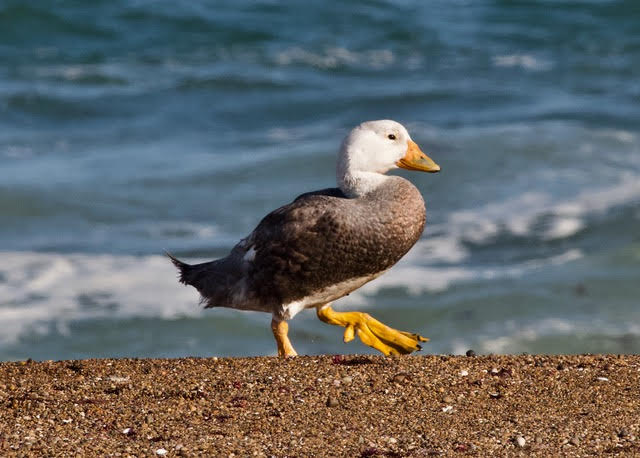
I was walking along a marked path observing the nesting colony and looking for other birds but nothing much was happening. I stopped at a Ranger’s post and chatted with him while watching the penguins coming going from the sea, and suddenly…but that is not a penguin!!! Indeed it wasn’t! Instead it was one of the birds that was atop my wish list. It was the endemic and vulnerable White-headed Steamerduck, which unlike other steamer ducks, is flightless and only inhabits a small portion of the eastern coasts of Argentina (particularly in the Province of Chubut).
White-headed Steamerduck (male, male, and female)
I told the Ranger about the importance of that species but unfortunately he did not have the slightest idea of what I was talking about. Fortunately, later I spoke to Tania (another ranger) and she was more aware of this species and their Vulnerability.
After this chance encounter I did not expect or even wish much more to happen, so I headed to the former lands of Mr. Cameron with a wide smile and great happiness! What will I find next?
]]>A Zillion Miles of Birding: Days 1-3
https://birdsinfocus.com/blog/2019/11/30/a-zillion-miles-of-birding-days-1-3/
Sat, 30 Nov 2019 03:46:04 +0000http://birdsinfocus.com/blog/?p=486Continued]]>I first met Matías Torreguitar in May 2018 at about 5:50AM in the bustling Buenos Aires airport. My wife and I had just landed, and Matías had graciously agreed to meet us at this very early hour. With a broad smile he welcomed us to Argentina! It didn’t take long to confirm that we share an enthusiasm for birds and exploring nature, and I count myself as very lucky to have traveled with him to a number of his favorite spots across southern Buenos Aires Province.
Matías and I have kept in touch, and it was in a recent email that I learned the exciting news that he would soon be adventuring across much of southern Argentina (Patagonia). His trip started on November 19th and every day or two he sends another update. These emails have been so enjoyable that I asked if I could share them here in blog format. This is the first installment…the first 3 days of adventure. Travel vicariously with Matías as he searches for birds, and if you feel the need to join in, be sure to support his work by buying his eBook (a bargain at just $5).
November 19, 2019 – Day 1
Last year, and the year before that, I dreamt of a birding voyage of a lifetime. The idea was to start from Quequén (Buenos Aires Province) and travel to Santa Cruz Province, deep in the wild heart of Patagonia, to assist with a Hooded Grebe protection program. Once my duties there are complete I’ll follow the stunning Andes Range north and return to Quequén: a zillion kilometers of birding!
But it is not easy to arrange everything that is needed to travel around Patagonia, so the dream was kept on hold. This year (2019) looked difficult also, but with my wife’s support I was finally able to put the plan into action, and at 6:30AM this morning, the adventure started! Instead of driving our newest car I fixed up an old 1996 Legacy with almost 400,000 kilometers on it (roughly 250,000 miles) and hit the road at first light. My driving speed will be around 100 kph (~62 mph) and I will travel for more than 8,000 kilometers (about 5,000 miles). My intention is to go south along the coast of the Atlantic Ocean up to a place called Caleta Olivia in the Province of Santa Cruz, from there go west to the village of Perito Moreno (northwest Santa Cruz), and after staying a month assisting with the Hooded Grebe Project, return north Along the Andes Range to a given point (undecided yet) and back to Buenos Aires. The overall plan is to assist endangered species, to photograph endemic birds, and to enjoy the greatness of a very unique region. Please join me in my adventure via these blog updates, and if you decide to plan your own trip be sure to use my Field Guide to Birds of Patagonia and the South Atlantic (Kindle Edition) as a resource! I’d also enjoy having you follow Extreme South Birding on Facebook at well. Now back to my adventure!
Starting odometer
I wished to do it as old fashioned as possible, so instead of a GPS unit I grabbed a map of Patagonia. My first stop would be the city of Viedma (about 600 kilometers / 375 miles) down the road.
I did not expect much on this first part of the trip, but once I passed the city of Bahia Blanca (southern Buenos Aires Province) I started observing a number of meadowlarks. I began to think of the Pampas Meadowlark, an almost endemic bird that I forgot to include on my wish list. The National Road 3 was busy enough that I could not stop at most of the birds to see enough detail. So I decided to turn at the first dirt road that came along. The name of this particular road was not very promising: Ox Head Trail (Camino Cabeza de Buey). In fact, road is not really the right word either, as this dirt path was definitely rough…but somehow it looked just about right as a place to find the Pampas Meadowlark. Sure enough, after taking around 1,000 photos of Long-tailed Meadowlarks (a very similar species that is best told apart in flight), I found a slightly smaller bird, with darker upperparts, brighter red underparts, and a slightly smaller bill. I took several photos but the clincher came when the bird flew…it had dark underwings (unlike the whitish underwings of the Long-tailed Meadowlark)! Unfortunately I did not get a flight photo to share, but the visual confirmation still got me excited.
Pampas Meadowlark
This was not the only surprise the Ox Head Trail had for me. There were a number of White-tipped Plantcutters (males, females, and juveniles), I took some good photos of them but did not worry too much because I have a large number of good ones in my files. As I always do after a day in the field, I downloaded the photos and started reviewing them…hundreds of meadowlarks, several male and juvenile plantcutters, and… oh!!! that is not a female White-tipped Plantcutter. What is it?… I checked the Field Guide I wrote and there it was listed under the Rhynocryptidae Family. The species was the very rare Crested Gallito (and another lifer!!)
Crested Gallito
The Ox Head Trail proved to be a fantastic place for birding, besides the above species I saw a Cinereous Harrier, Turkey Vulture, and a number of local species that I’ll continue mentioning as I keep writing. So far so good; and I still have at least 4400 miles to go.
November 20, 2019 – Day 2
My second day was planned well in advance, and the region that I would visit is home to the largest Burrowing Parakeet colony in the world. In a sense that is not saying all that much as this member of the Psittacidae Family is almost endemic to Argentina (there is also a small colony in northern Chile), however this is no ordinary colony. Starting near the village of Balneario el Condor this colony finishes almost 200 kilometers later at Caleta de los Loros!
I left Viedma at 7:30AM. I was now much deeper in Patagonia and there were several warning signals that I should have paid attention to, including this sign informing of no gasoline stations for 200 kilometers. But gas wasn’t on my mind at that moment…there were parakeets to photograph!
I arrived in the parakeet realm and it was amazing. There were thousands to the point that it was hard not to drive into them. The coast from El Condor to Caleta de los Loros is basically a never ending cliff where Burrowing Parakeets nest. If you come close, several hundred would leave their burrows with loud warning calls and fly in different directions…only to return about a minute later.
I stood there for a long while, watching amazed and trying to obtain at least one decent photo. I think that several were quite good.
Burrowing Parakeet
Burrowing Parakeet
I kept driving past the small village of Bahia Creek hoping to continue with my birding until I arrived to San Antonio Oeste where I was going to get gasoline, but of course things could not be that easy. About 20 kilometers later a sign stated that the “road was closed”. The fuel gauge of the old station wagon wasn’t happy and it estimated my range at 410 kilometers. Basically I had to choose between two bad options: 1) return to Viedma or 2) take a different road to San Antonio Oeste. Both were right at the range of my Legacy. I reduced my speed to 70 km/h and decided to proceed toward San Antonio.
The Turkey Vultures were circling already!
Along the way a few Turkey Vultures seemed to be expecting the worst for me and kept taking advantage of the thermals to fly circles over me.
After a tense drive San Antonio appeared in the horizon, I refueled, and continued to Puerto Pirámides in Peninsula Valdes where I had everything planned but…what sort of an adventure would this be without the unexpected?
November 21, 2019 – Day 3
My plans for the 3rd day were special. I would return to Península Valdés which is one of my favorite places on earth. I arrived from Viedma quite late and fortunately I found a comfortable place to stay. Next I called my wife while I was going to get dinner telling her of the misfortunes I had on the way to Peninsula and my ideas for the following day.
That night I stayed at Puerto Piramides, and early the next morning I planned to set my camp in Caleta Valdés (east Peninsula Valdés) to observe one of my targeted birds…the Magellanic Penguin. In fact my camping would be only a few hundred yards from one of the largest colonies for this species!
The solitude and greatness of Caleta Valdés goes beyond any explanation. It is a sacred place where everything seems to fit to perfection. I was the only person along a 30 km stretch of beach. This was possible because I had a special permit from the owner of the land, otherwise no-one can enter the grounds of Caleta Valdés because it is a Reserve with no public access.
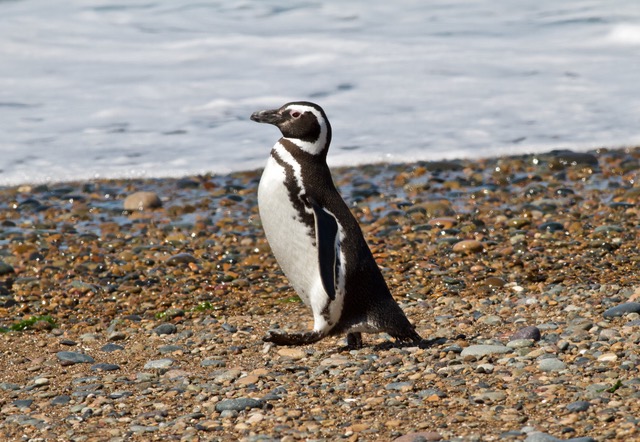
There are thousands of penguins that share duties, some (could be male or female) incubate the eggs while others search for food and then they switch. There is a constant coming and going, but there is also time for chatting and relaxing…
Magellanic Penguin
Magellanic Penguin
Magellanic Penguin
But not everything is joy in “penguin land”, there are important matters to worry about…
Península Valdés is an amazing place, but it is always reminding you to have a plan B so you don’t end up like this…
I spent the complete day at the beach observing these wonderful animals and their environment. I missed my wife, Andrea, because we visited this location together two years ago. I promised her that we would return and visit it together again.
Tomorrow I will seek another of my targeted birds.
]]>Whistling in the Tropics
https://birdsinfocus.com/blog/2018/12/27/whistling-in-the-tropics/
Thu, 27 Dec 2018 21:27:37 +0000http://birdsinfocus.com/blog/?p=284Continued]]>It’s a familiar feeling for those who love birds. That extra gravitational tug that a truly special species can create. It’s a force that results in a slightly unreasonable cycle of planning, dreaming, strategizing, hoping, and still more dreaming. One such bird for me was the Whistling Warbler (Catharopeza bishopi). This 5-6 inch long denizen of the rainforest understory lives on only one island on the entire planet: St. Vincent.
St. Vincent is a beautiful Caribbean island located in the Lesser Antilles just 27 miles south of St. Lucia and 185 miles north of the South American coast. The oval island is volcanic in origin, a fact that is not lost on anyone who sees 4,049 ft La Soufrière dominating the northern end. This active volcano has erupted three times since 1900, with the most recent in 1979. These rich volcanic soils combine with 50-150 inches of annual rainfall to support lush tropical rainforest and palm brake forests. These habitats in turn support several very unique, range restricted birds.
Some of the beautifully forested mountains of St. Vincent
Perhaps the most mysterious of these endemic birds is the Whistling Warbler. This dark warbler has a striking white eye ring and a clear band of white across the throat. To me this species looks like the combination of a redstart and an Old World fantail. Owing to their uniqueness they occupy their own genus: Catharapeza. Skulking in the underbrush this warbler belts out a series of clear, crescendoing notes. It’s the type of song that pierces the forest, freezes you in your tracks, and forces a usually futile search for the source.
Press play to enjoy a few a second of peaceful rain forest and then the lovely song of the Whistling Warbler. Recorded via iPhone by Judd Patterson in May 2018.
This Whistling Warbler trip began several months earlier when my friend, Dan Clark, contacted me and expressed interest in an adventure. I’m an obsessive trip planner and I had several potential Caribbean destinations in mind. After reviewing our options, we both settled on St. Vincent as a unique island with several challenging birds. It wasn’t long before I discovered that airfare to Barbados was particularly affordable, and it would put us within 100 miles of our target. Soon we had our tickets booked: Miami to Bridgetown, Barbados on American Airlines and Bridgetown on to Kingstown, St. Vincent on LIAT.
Next up was to do as much research as possible, so I scoured every book, trip report, and checklist that I could find. I looked for clues on the locations, times of day, microhabitats, and sounds that would improve our chances of seeing and maybe even photographing our target. I also contacted guides in the vicinity and was ultimately put in touch with Lystra Culzac of the Science Initiative for Environmental Conservation and Education (SCIENCE). Lystra was fantastic and before long she had helped us plan a couple of days with Glenroy Gaymes, a local Foresty Officer. I knew their local knowledge would greatly improve our chances.
The months ticked by and in late May it was finally time to go! We transited through Barbados which turned into a fun destination as well. I’ll save those details for another blog entry, but suffice it to say we were thrilled by birds like Barbados Bullfinch, Little Egret, Eurasian Spoonbill, and Masked Duck. Our LIAT flight was smooth and we landed on St. Vincent around 9PM and settled into our hotel as a steady rain pounded down on the roof.
That first morning we met Glenroy at 4:30AM and headed to the north end of the island. Over the course of the next two days we visited several gorgeous locations and photographed many of our other targets, including St. Vincent Parrot, Lesser Antillean Tanager, Scaly-breasted Thrasher, and the local Bananaquits (which are entirely black). All of those species were fantastic, but the one that I still wanted to see the most was the Whistling Warbler.
Working our way up one nearly vertical forest trail we heard the beautiful, captivating Whistling Warbler song for the first time. Slapping mosquitoes and trying to find firm footing on the muddy, narrow steps we waited impatiently for the song to be repeated. A few minutes later it rang out a second time, even closer now, and a flash of movement above our heads materialized into an adult Whistling Warbler! But the moment was fleeting, and the warbler, with those boldly contrasting black and white bands, quickly melted back into the forest. Despite spending time in good habitat those two or three seconds turned out to be our only glimpse on the first day, and the reality of the challenge began to sink in. There were good reasons why relatively few photos exist. Whistling Warbler aren’t common, they don’t perch in the open, and their forest home is generally dark and rainy. Getting a solid photo was going to take time and a healthy dose of luck.
On the second day we checked out another high elevation site where Whistling Warblers had been seen in recent weeks. Walking this trail we found several spots where birds were singing. Glenroy had the ability to squeak with his teeth in just the right way to attract birds, and this technique brought one Whistling Warbler in over our heads. Once again the field marks burned into my eyes, but getting a photo was out of the question. The bird was simply too fast and was gone in an instant. The beautiful song echoed on up the mountainside as the warbler disappeared.
Our third day was our final on the island, but I had strategically booked a 9PM flight back to Barbados to give us enough time to visit one more location…one more chance. Today we were on our own and we visited the Vermont Nature Trail. This is a well known trail for anyone interested in nature and wildlife on the island, and it did not disappoint.
As we hiked our way to the top, lugging the big camera gear with us, I began to hear St. Vincent Parrots flying overhead. I set off at a quickened pace toward the famous parrot overlook that I’d read about in trip reports. The canopy was thick over the the trail and it seemed like the overlook would be the only chance to see a parrot in flight. But before I reached the top, the beautiful song of a Whistling Warbler burst from the undergrowth directly in front of me and set my heart racing. The song was incredibly loud and clear. This bird was close! I found as level a patch as possible on the rocky trail and setup to wait for the bird to move.
Thankfully the bird did come into view several times over the next two hours, and Dan and I did our best to track its sporadic movements and capture photos. It was a challenging endeavor, and unlike much of the literature that I had read, this bird seemed to prefer the mid to upper canopy where it was foraging for caterpillars and other insects.
Whistling Warbler
Success!
Whistling Warbler in full song
Dan and I gave each other high fives and couldn’t get over our good luck in finally succeeding in our quest for a Whistling Warbler! We descended the trail knowing what a true privilege it was to have seen this rare species so well. According to the latest IUCN estimate, there are 2,000-3,300 mature individuals of this endangered warbler remaining…and I couldn’t help but wonder if this was an overly optimistic estimate.
All across the Caribbean there are similar stories of amazing endemic birds that inhabit single, small islands. Hopefully photos like these will help people learn about these little jewels and to protect the spots they call home.
Happy photographer!
]]>2018 Taxonomy Updates
https://birdsinfocus.com/blog/2018/08/31/2018-taxonomy-updates/
Fri, 31 Aug 2018 23:53:33 +0000http://birdsinfocus.com/blog/?p=332Continued]]>
Several years ago, we at BirdsInFocus.com made an internal commitment to synchronize our website’s taxonomy with the annually updated eBird/Clements Checklist. This has allowed us to stay as current as possible, for every bird species in the world, on the nomenclature now used by a rapidly growing majority of the world’s birders.
It’s always a labor-intensive process, and ironic health issues prevented me from completing the 2017 updates until this year, but I’m very pleased to announce that we’re now back on schedule. We incorporated all of the 2017 and 2018 taxonomic revisions just one week after eBird released its 2018 updates, making BirdsInFocus once again one of the most up-to-date bird photography websites in the world.
We now have nearly 12,000 high-quality photos online representing 2,153 species of birds from 30 countries on six continents, several islands, and at sea. With the latest taxonomic updates, we’ve added two new orders and six new families:
]]>Caribbean Bird Relief
https://birdsinfocus.com/blog/2017/11/01/caribbean-bird-relief/
Wed, 01 Nov 2017 04:29:22 +0000http://birdsinfocus.com/blog/?p=245Continued]]>
Antillean Crested Hummingbird
St. John After Hurricane Irma (NPS Photo)
In September 2017 Hurricane Irma and Maria brought incredible destruction to numerous islands across the Caribbean. Many people awoke after these storms to a new reality of damaged or destroyed homes and natural habitats that were barely recognizable. With trees stripped bare or killed outright, there was an immediate concern that some endemic bird populations, or even entire species, could disappear. How adaptable are these species when food resources are stretched thin? Can the birds make available food last until the plants recover? Previous research after the passage of Hurricane Hugo in 1990 confirmed the hunch that nectarivores and fruit/seedeaters (e.g. Bananquits, caribs, and quail-doves) declined much more than birds that feed on insects or other animals (e.g. flycatchers and raptors). On St. Croix, Hugo forced some species like the Antillean Crested Hummingbird and Bridled Quail-Dove to the very brink.
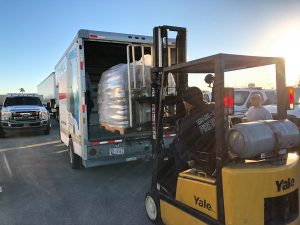
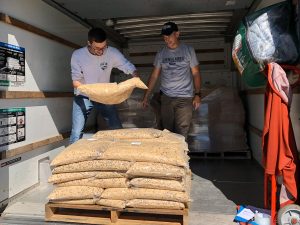
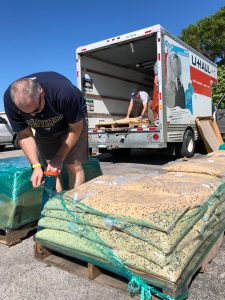
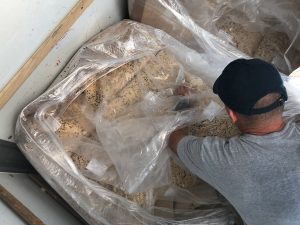
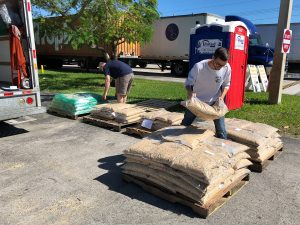
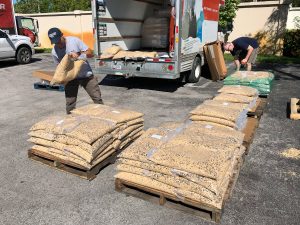
Even as Irma and Maria were still churning, groups began to mobilize donations and volunteers to get hummingbird feeders and bird seed to these islands as quickly as possible. One particularly large donation of 8,000 pounds of bird seed was acquired by Birds Caribbean and shipped to a warehouse in Homestead, FL. As someone who lives and works close to Homestead I wanted to help. On October 30th a couple of good friends joined me at a Miami-Dade Fire Rescue warehouse and loaded as much seed as we could safely carry. With the help of several firemen we had 6,000 pounds on board in short order and headed north to a shipping company in Miami.
Bananaquits drinking homemade nectar…known locally as sugar birds
Bridled Quail-Dove
Throughout that afternoon we unloaded, sorted, wrapped, and labeled stacks of bird seed in piles ranging from 250 to 1100 pounds (based on the size of the islands). In all we were able to help Birds Caribbean get bird care packages out to 9 different islands/countries including: Anguilla, Antigua, Bahamas, British Virgin Islands, Dominica, Turks and Caicos, St. Croix, St. John, and St. Thomas. Additional seed was sent directly to Puerto Rico, and future shipments are scheduled for still more islands.
The next phase begins when these shipments arrive at the final ports and are picked up by local researchers and birds lovers for distribution. It was incredibly encouraging to see the first success in mid-October when 300 pounds of seed and hundreds of hummingbird feeders arrived on St. Maarten and were distributed to many enthusiastic residents. That was one step in the right direction in what is sure to be a long road to recovery for both the people and wildlife of the Caribbean. Thanks to all of those who played a role in this operation including Lizzie Mae’s Bird Seed and Dry Goods, Freeport Wild Bird Supply, and Birds Caribbean!
]]>Endemic Birds of St. Lucia
https://birdsinfocus.com/blog/2017/05/26/island-paradise-endemics-of-st-lucia/
Fri, 26 May 2017 03:45:29 +0000http://birdsinfocus.com/blog/?p=168Continued]]>St. Lucia just might be paradise. Situated in the eastern Caribbean, this small island — just 10% of the size of Miami-Dade County — enjoys a tropical climate that is moderated year-round by pleasant northeast trade winds. Volcanic in origin, St. Lucian peaks rise more than 3,000 feet from the Caribbean Sea, and the island features diverse habitats including rainforest, dry forest, banana/cacao plantations, and gorgeous beaches. This landscape is home to a wide variety of unique plants and animals, including 5 endemic bird species (meaning they are found no where else in the world). It was these unique birds that first drew my attention. After a burst of planning I had a 5 day itinerary and a pair of frequent flyer tickets for my girlfriend and I to enjoy.
Upon landing I adjusted my driving style to favor the left and began zigging and zagging along mountainous roads along the southern shore. It wasn’t long before the amazingly beautiful Pitons came into view. These remnant lava domes are 2,500 feet of sheer rock (and beauty!) and are preserved as part of a UNESCO World Heritage Site.
The first endemic bird that caught my eye was the lovely St. Lucia Warbler. They are relatively common on the island, and in late April numerous males were signing from the treetops. Until recently the AOU lumped this species with the similar Adelaide’s Warbler (Puerto Rico) and Barbuda Warbler (Barbuda), but differences in song, plumage, mitochondrial DNA, and range mixed things up (in 2000) and will probably keep this one split.
St. Lucia Warbler
St. Lucia Warbler – singing
We were fortunate to spend a day birding with Adams Toussaint who works for the St. Lucia Forestry Department. Adams is a top-notch guide with an knack for finding good birds, and a broad understanding of the issues facing St. Lucia. As we chatted about threats from causeway construction, hotel development, and a dolphin park we walked through beautiful forest and continued to discover new birds.
The next endemic is known as the St. Lucia Pewee by many authorities, while Clements/eBird still calls it the Lesser Antillean Pewee. I really loved the rich rufous of this spirited little flycatcher. We noticed one individual had a bad eye, but remarkably that didn’t seem to stop it from grabbing in-flight insect snacks from a favorite perch.
St. Lucian Pewee
As our adventure continued we saw the St. Lucia Oriole at a few locations across the island. Like many of the endemics, it is not abundant (estimated population of just 1000-2500) and it is is under threat from an increasing population of Shiny Cowbirds that lay their own eggs in oriole nests.
St Lucia Oriole
Endemic #4 is the St. Lucia Black Finch. It’s frequently mentioned that this bird shares a family tie with the Galapagos finches. As members of Thraupidae (Tanagers and Allies) this is technically correct. However, this same family also includes Bananquits, grassquits, and Antillean bullfinches, so the mystery is not as deep as it may seem at first blush. It’s a beautiful little bird that is endangered (estimates of 250-1000 remaining) and difficult to photograph. With help from Adams we were able to get close to a cooperative male finch, and a cloud provided the perfect, soft light.
St. Lucia Black Finch
I’ve saved my favorite for last. How couldn’t you love a big, beautiful parrot? The St. Lucia Parrot is one of 9 native Amazona parrots in the Caribbean, and it sports a riot of color including blue on the head, red on the belly, and bits of yellow and green scattered throughout. Sadly by the late 1970’s deforestation and trapping for the pet trade had driven the population perilously close to extinction. In 1976 Jovicich concluded that:
Saint Lucia’s remaining Amazona versicolor population of 150 ±25 is fast approaching extinction in the wild … and considering the overall trend of man’s simplification of Saint Lucia’s ecology, it is certain that Amazona versicolor will not escape oblivion.
Those are scary words to read from a researcher who knew these parrots so well.
Thankfully during the 1970’s and 1980’s there were a number of positive changes. In 1979 St. Lucia gained independence from the UK and they quickly named the parrot as the national bird, enacted new wildlife protection legislation, and initiated a captive breeding program. The success of these measures is obvious today and parrots now number 350-500 and the population continues to expand.
St. Lucia Parrot
St. Lucia Parrot flyover
Our 5 days exploring St. Lucia came to an end all too quickly, but I was very happy to have seen and photographed all 5 endemic species and a wide variety of other Antilliean endemics such as the Gray Trembler, Purple-throated Carib, and Lesser Antillean Saltator. For such a small island, St. Lucia has a lot to offer to a nature enthusiast. I would highly recommend the wonderful combination of amazing views, outstanding food, and beautiful birds that is St. Lucia!
Judd in the wild
]]>A Plover Named Erwin
https://birdsinfocus.com/blog/2015/08/19/a-plover-named-erwin/
Wed, 19 Aug 2015 04:24:21 +0000http://birdsinfocus.com/blog/?p=143Continued]]>Sometimes you just stumble into a great story through photography. That was the case back on February 16, 2014 when I traveled to the west coast of Florida to one of my favorite shorebird photography spots. Bunche Beach is well known for wintering Marbled Godwit, Long-billed Curlew, Black-bellied Plover, Semipalmated Plover, and many more great birds. My primary target that day, however, was the Piping Plover. The previous spring I had followed a breeding pair of these birds along a beautiful rocky beach in New York. I was treated to sweet moments with both adults and their adorable cotton-ball chicks.
Piping Plover adult and chick
On this particular trip to Bunche Beach I was hoping I could add a non-breeding Piping Plover to my portfolio. As I roamed the recently exposed mudflats, I worked my way through more common species like Dunlin and Sanderling until I finally found my target. Foraging in the morning sun was a beautiful Piping Plover. He was sporting several bands on each leg..various shades of yellow, black, and gray. He posed for several photographs, and I returned home happy.
As I reviewed those images I decided to send off the information on his bands in the hope that I could learn about his previous whereabouts. What I got back was really fascinating. This little plover had a name: Erwin. Erwin was banded as a tiny chick on June 16, 2011 at a lakeshore housing development in Dodge County, Nebraska. That first winter after hatching Erwin made his way more than 1,300 miles to southeast Florida. There is no information on his location during the 2012 breeding season, but by the fall he was back at Bunche Beach. In the spring of 2013 he returned to Nebraska where he successfully nested. Each winter since he has returned to Bunche Beach where he is seen by many birders and photographers. It’s pretty cool to get such insight into the migration preferences of this one little bird. Weighing only a couple ounces, Erwin is a classic snowbird…spending his winters lounging on the beach in Florida! With a little luck I’ll run into him again this season.
]]>Long-whiskered Owlet and Peruvian Endemics
https://birdsinfocus.com/blog/2015/08/05/long-whiskered-owlet-and-peruvian-endemics/
Wed, 05 Aug 2015 23:51:07 +0000http://birdsinfocus.com/blog/?p=132Continued]]>Long-whiskered OwletXenoglaux loweryi
The Long-whiskered Owlet is one of South America’s most elusive birds. It is strange, tiny, nocturnal, shy and endangered; sounds like the perfect bird to search for!
In 1976, ornithologists from Louisiana State University were surveying birds in a remote cloud-forest area in the Andes Mountains in Northern Peru. They were stunned when they captured a bird, in a mist net, that was unknown to science. The bird was a tiny owl about five-inches tall. It had a wild look with bright, orange eyes, stubby wings, short tail, and long facial whiskers. The bird was so unusual it was given the scientific name of Xenoglaux, which means “strange owl”. Twenty-five years would pass before it again showed up in a mist net, in the Abra Patricia (Patricia Pass) area, where it was initially discovered. It was classified as “endangered” and the population was estimated to be 250-1000 individuals. But this was only a guess, as an accurate count was impossible due to the bird’s elusive nature and its habitat of mountainous cloud forest, with dense undergrowth, lush with epiphytes. Not until 2007 was the bird finally observed in the wild. This time it was also recorded. With this recording, more thorough searches were then possible. Another bird was seen in 2008. In 2010 another was seen and five were heard. It has now been located in a total of three sites.
From July 11-24, 2015 a group of ten of us traveled on a Mondo Verde Expeditions birding journey to Northern Peru. Trip participants were Bob Gress, Kevin and Laura Groeneweg, Jim and Patty Marlett, Art and Karen Nonhof, Will Chatfield-Taylor, Mario and Jeanine Corvetto, and our birding guide Silverio. On July 14-16 we stayed at Owlet Lodge at Abra Patricia where there is “a chance” to see the owlet. In recent years, the birds have been seen in this area but have become increasingly difficult to locate, probably due to birding pressure and their reluctance to respond to playback. On the evening of July 15th, Silverio, Patty, Kevin, Karen, Jeanine, Will and I traveled down the highway to the Alto Nieva private nature reserve. We hiked along a beautiful canyon stream into dense cloud forest. In a small grove of wild bamboo, beneath the cloud forest canopy, we turned off our lights and waited quietly in the dark while bats darted above us. Once fully dark, the guide from the reserve quietly played the call of the Long-whiskered Owlet. Within ten minutes an owlet flew in and called softly in response. The bird was tiny and about 30 feet away! Restricted to only the guide’s flashlight, viewing was done quietly and quickly. Several of us attempted photos with the flashlight beam. As expected, they were dark and blurry. Those of us with camera flashes were allowed only a few flash attempts. I took five. There wasn’t much room for error or to fine-tune the process. This image was my best. With big smiles beneath our headlamps we hiked quietly back through the dark. The feeling was exhilarating! We had just seen and photographed the near-mythical Long-whiskered Owlet!!!
Success!
Here are a few other birds found only in Peru (endemic) that share this unique cloud forest habitat with the Long-eared Owlet at Abra Patricia:
Bar-winged Wood-wren
Johnson’s Tody Tyrant
Ochre-fronted Antpitta
Inca Flycatcher
Royal Sunangel (female)
Does chasing endemic birds in the Andes interest you? Here’s your chance. This time we are going to explore Colombia! Time is quickly running out to join us. I need to know ASAP if you are interested. Let me know ASAP and I’ll send the complete itinerary, costs and tempting bird list. Email me ASAP at bobgress@cox.net. Look over the information and then let me know ASAP if you want to join us. Don’t’ wait if you want to go!
JOIN US IN COLOMBIA!!!!! — February 7–27, 2016
With over 1,850 bird species, Colombia is credited with having the largest bird list of any country in the world! Colombia also has over 70 endemic birds (found only within the country). This birdwatching trip concentrates on endemics in the Colombian Andes but we’ll find plenty of other species along the way. Recent trips on this route have yielded over 500 species! What an amazing destination! Our guide will be an experienced Colombia birding tour guide and in some locations we’ll also work with a local site expert. This is a trip for birdwatchers. Participants should be in good shape and able to hike comfortably over trails and across a variety of habitats. Early mornings departures are normal. This trip is limited to only 8 participants so let me know ASAP if you would like to receive an itinerary. We must fill this trip by early September in order to finalize lodging arrangements. The itinerary will include all the details of locations, birds that may be seen, lodges and hotels, cost details, registration information, and payment deadlines. Let me know if you have any questions. For the itinerary, email me at bobgress@cox.net.
Our goal at Birds In Focus is to provide a single location for top-quality bird photographs. We offer our images as prints and for use in publications. Each photograph is tagged with ornithological details and available through fast, dynamic searches. New images are added frequently, and we certainly entertain special requests. You may enjoy viewing some of our favorite images, recent publications, or photos from this day in history. Thank you very much for visiting.
-Bob, Judd, and David
Photo of the Day
Currently showcasing 17,184 images (+0 this month, +22 last month) representing 2,848 species from 39 countries.
Copyright Notice: All photographs on this site are protected by United States and international copyright laws. Photographs are not to be printed or otherwise published without permission.

 |
|